
Mowing advice for grassland: cut at the right moment
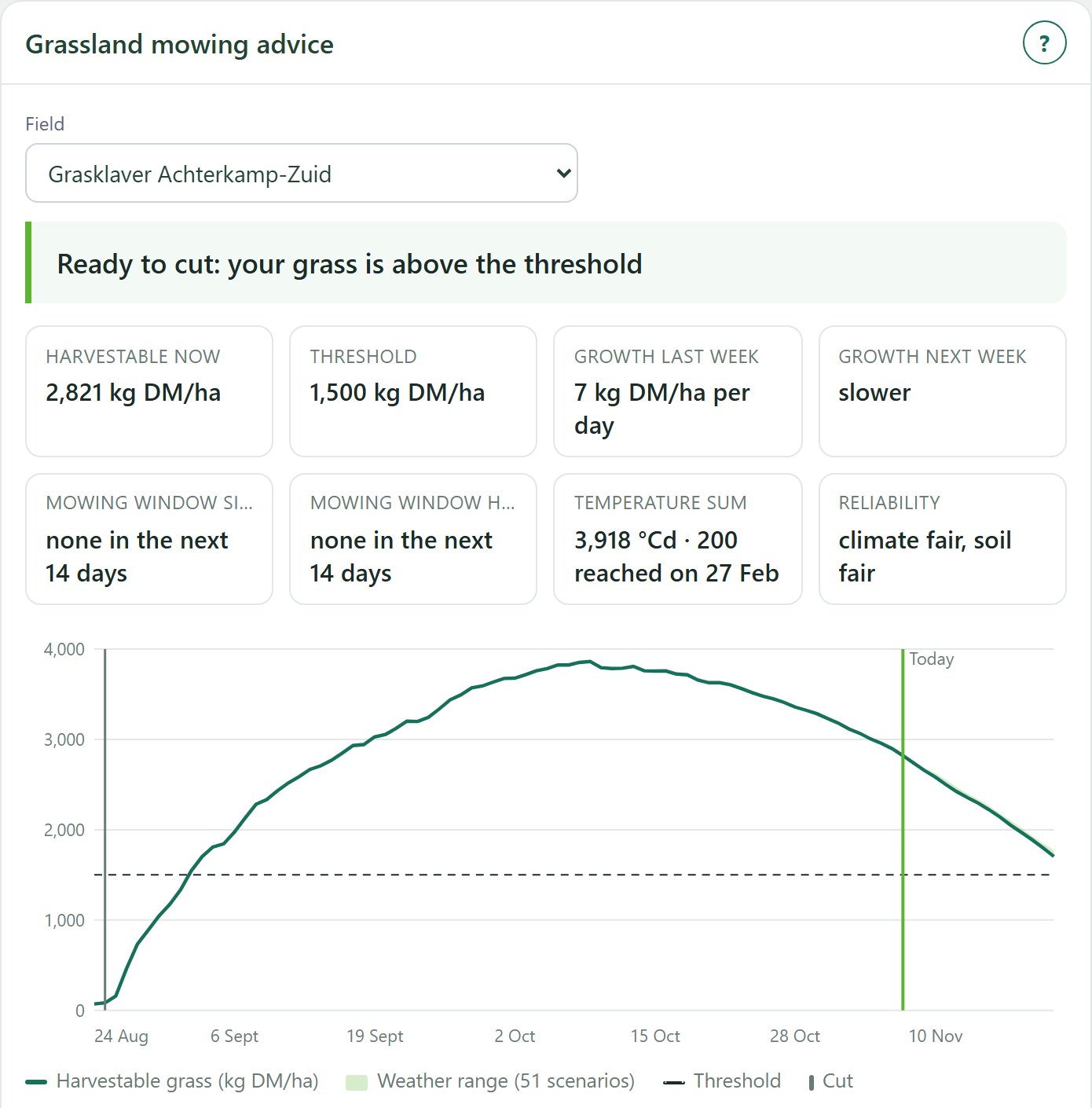
Every day FairGrow calculates how fast your grass is growing, when it is ready to cut and when it is dry enough to mow and make silage. Per field, from the weather, your soil and what you record yourself.
Timing is everything
Cutting too early costs yield. Cutting too late costs quality. And a cut lying in the rain costs everything.
On top of that, no two fields run the same. A wet clay field and a dry sandy knoll can easily be a week apart in spring. That is why the mowing advice works per field, not per region.
From weather and soil to the moment to mow
Three kinds of input, a daily growth calculation, three answers. Tap or hover over a block for an explanation.
Tap or hover over a block for an explanation.
Weather, two weeks ahead
Measured weather until yesterday and the forecast for the next fourteen days, in 51 scenarios. So you see not just a date, but also how certain it is.
Your own soil
How much water your soil holds and, in the Netherlands, how deep the groundwater is. Upload a soil analysis and we calculate with your figures.
What you record anyway
Cuts and fertilisation from your crop records. After a cut the advice is up to date again within fifteen minutes. Nothing to enter twice.
Your feed purpose
Young, protein-rich grass for the dairy cows, a heavier cut for young stock, hay or grazing. You choose per field, or set your own threshold.
You see why the advice is what it is
Behind the advice are growth models from science, tested against field trials for decades. Within FairGrow we link them to your own field.
With every piece of advice you can open “How do we calculate this?”: which weather, soil, fertiliser and threshold went in, and what came out. So you can also see for yourself when your knowledge of the field knows better.
A label that says how certain the advice is
Every piece of advice gets a reliability in two parts: how well the models fit your climate and grassland, and how well we know your soil.
North-western Europe, ryegrass
This is what the models were built and tested for. The climate part of the label is usually high.
Mountains, drought or mixed grassland
You see it in the label, and the advice says why. Tell us whether you irrigate and we take that into account too.
Outside the range of the models
Where the models do not know the grassland well enough, we give no date. Satellite images still show whether your grass is growing faster or slower.
With a soil analysis
Without an analysis we use the soil map. Upload your lab report and the advice calculates with your soil, and the soil part of the label goes up.
The direction counts more than the number
We know from practice that a farm can sit structurally above or below a forecast while the direction is right. So you first see whether your grass is growing faster or slower this week than last week, and only then the kilos.
For everyone who mows grass
Dairy farmer
Ready to cut per field, the best window for silage and hay, and a feed purpose per field: young, protein-rich grass for the dairy cows or a heavier cut for young stock.
Book an intro →Agricultural contractor
Soon you will see your customers' fields on one map, sorted by ready to cut and mowing window. We are working on it now, and would like to hear what you need.
Think along →Horse owner and small hay meadow
When to mow, and when is it dry long enough to make hay? In plain language, without kilos of dry matter up front.
Book an intro →Organic and grass-clover
We currently calculate grass-clover as grass with a good clover share, and we say so honestly. A dedicated grass-clover model is in development, with a pilot in 2027.
Join the pilot →Record once, the right figures everywhere
Every cut you record carries through: into your nitrogen balance, into the carbon balance of your grassland and into your harvest overview.
Less paperwork, more time in the field.
For banks and supply chain partners
Feed security and drought risk per farm, backed by the same calculation the farmer sees. As part of the risk profile, and only with the farmer's consent.
Frequently asked questions
Does it work outside the Netherlands?
Yes. Outside the Netherlands we use a global soil map and the local climate. The reliability label shows how well the models fit your situation.
Does it work for grass-clover?
Yes, as an approximation: we assume a good clover share. With little clover your field grows slower than the advice says. A dedicated grass-clover model follows after the pilot in 2027.
Do I need sensors?
No. The advice works with weather, soil and your records. With a soil moisture sensor in a field we will soon know even better how wet your soil really is.
What does it cost?
The mowing advice is part of the Grower subscription. Book an intro and we will show it on your own fields.
Who sees my data?
Only you and whoever you give access, such as your contractor or advisor. Your data is stored on our own servers in a Dutch data centre.
Does it replace my advisor?
No. This advice is based on models, weather data and your records. It provides technological background information and does not replace an advisor.
Curious what the mowing advice says about your fields?
Leave your details and we will show you. You will hear from us personally within two working days.
This advice is based on models, weather data and your records. It provides technological background information and does not replace an advisor.