
Citronella: on the organic list, yet no product
Three EU rules, and they never meet. Here is how it works.
The two conditions already excluded each other. Since June 2025 the approval is gone as well.
Three facts, one outcome
Deleted as of June 23, 2025
No renewal applied for, or the application was withdrawn (2025/1092). There was no refusal.
So: no product
A substance from the organic list may only be used in an authorized product. There is none.
Why it never fit
Put the two conditions side by side and nothing is left. Not even before June 2025.
FairGrow only shows a green label when the organic list, the approval and the overlap all hold.
Citronella oil you buy loose is not a plant protection product
Without an authorized product you may not use it as a plant protection product, not even in organic farming. In doubt, ask your inspection body.
Citronella oil as an insect repellent falls under different rules (biocides) and is not part of crop protection.
And outside the EU?
 European Union
 Great Britain
 United States
Minimum risk pesticide: exempt from federal registration. Many states require their own registration.
40 CFR 152.25(f)Rules elsewhere say nothing about what is allowed in the EU.
How FairGrow shows it
Typo? Still found
Citronella, citronella oil, Citronellöl, huile de citronnelle or 8000‑29‑1. The names come from 24 language versions of EU law, and FairGrow catches a small typo.
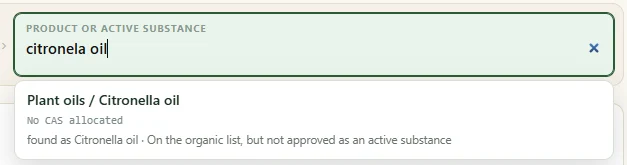
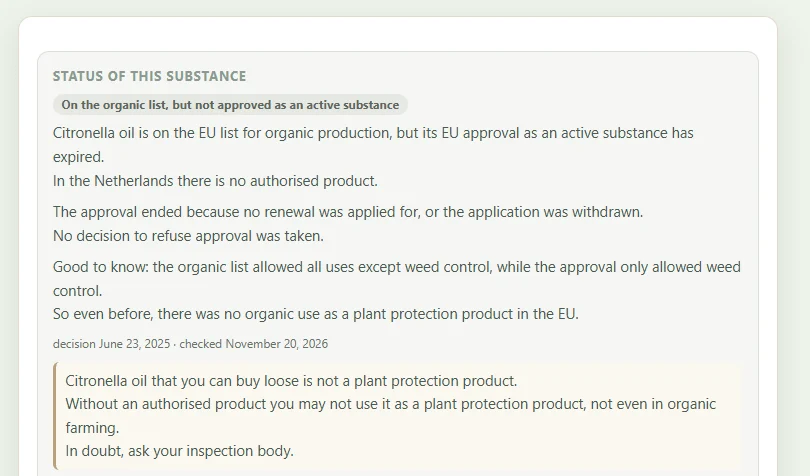
Status, reason and date at a glance
No green check and no dose, because there is no product. Instead: why, with the decision date and the day we last checked.
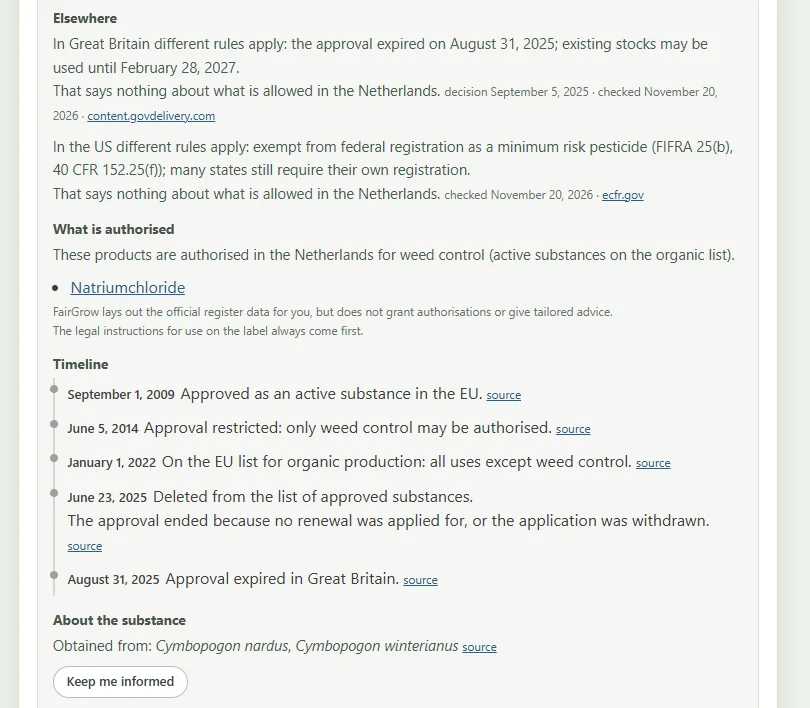
Timeline, rules elsewhere and follow
Every decision in a row, each with its source. Follow the substance and you hear when something changes.
Frequently asked questions
May I use citronella oil in organic farming?
Not as a plant protection product. That requires an authorized product, and there is none in the EU.
Then why is it on the organic list?
The organic list says which substances may be in a product for organic farming. Whether a product exists depends on the authorization. When the list took effect in 2022, the approval already allowed weed control only.
Is citronella oil banned because it is harmful?
There is no refusal decision. The approval ended because no renewal was applied for, or the application was withdrawn.
Can citronella oil come back?
Only if someone applies for and obtains a new approval, and a product is then authorized. Follow the substance in FairGrow and you will hear about it.
Look up a substance yourself
Every substance on the organic list, with its status per country and the source. Looking up is free of charge.
Sources
- Implementing Regulation (EU) 2021/1165, consolidated January 1, 2026, Annex I
- Implementing Regulation (EU) 504/2014, conditions of approval of plant oils/citronella oil
- Implementing Regulation (EU) 2025/1092, deletion from the Annex to 540/2011
- HSE Pesticides ebulletin, September 5, 2025
- 40 CFR 152.25(f), minimum risk pesticides
- EFSA FEEDAP Panel (2024): citronella oil from Cymbopogon nardus and C. winterianus
Checked on November 20, 2026. This is an explanation, not legal advice. The legal instructions for use on the label and the judgment of your inspection body always prevail.